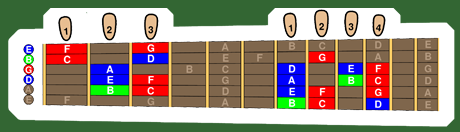
I've been exposed to music all my life and even built two guitars while still a teenager, but never learned how to sightread in the higher positions on the neck until resolving to do so after I retired in my upper sixties. My only regret is not learning to do it earlier, because of all the joy and pleasure it has brought to my musical experience.
It's only fair to warn you that my perspective is not that of a professional musician or educator; but that of a physicist, software developer, performance analyst, data modeler and inventor. A few years after my doctorate, I joined Bell Labs and its derivatives where I stayed until retirement. It was a culture of continual education, not only in technical matters but also in how people think (left brain, right brain, memory, reasoning, feelings, illusions, biases). While there, I was awarded several patents, mostly in the area of data modeling, which in itself is a discipline where you think about how people (and machines) think and organize information.
Mistakes in my own thinking have also been educational. Studying other languages has shown me that memory (at least my memory) is stimulus-based and directional: the ability to translate word A into word B in a second language doesn't automatically imply the ability to do the reverse. Both directions have to be built. And a bad experience learning Russian, where we were taught simplified rules at first and much later had to learn the real rules, taught me the difficulty and confusion of unlearning old memories.
Reflecting on all those experiences has strongly influenced my approach to guitar sightreading. Just as we can invent better ways for machines to think, so can we improve how we learn to sightread, from recognizing the need to learn two positions at once, to devising new diagrams that we use to build our memories of how to play the notes we see in the music. Thinking about thinking has produced real improvements that I'm eager to share with you.
This little book is a brief and gentle guide to learning the most important issue in sightreading on guitar: namely that there is more than one way to play the same note that you see in the music.
You will learn to sightread notes equally well in two positions on the neck, without ever looking at the fretboard. You'll recognize a note on the staff by its placement in the lines and spaces, and immediately know how to play that note in either position while continuously looking at the music.
If you've got a guitar and can see the music then you're ready. Well, you should also be able to play one note at a time (without looking at the strings) and be able to hear what you're playing (to check if sounds right).
It doesn't matter what size the guitar is or how many frets its has (so long as it's not fretless), but it has to be in standard tuning (E-A-D-G-B-E). Most of the pictures are for a right-handed guitar (right hand plucks/picks and left hand frets), but lefties are not left out.
How much music notation do you need to know? Not much. You have to be able to see where a note is placed on the staff, in comparison with other notes. Is it on a line? Or a space? Which one? The fingers on your left hand will need to know.
You should also understand that a note can have several different appearances depending on how much time the note is supposed to take (whole note, half note, quarter note, dotted). That will tell your right hand when to go on and play the next note.
But don't worry too much about getting the rhythms right at this stage. This book is more about your left hand knowing where to press than your right hand knowing when to play. If the left hand produces the correct pitches, you may recognize a familiar melody and then learn from that experience how the music notation reflects the real rhythm.
The truth is that there is more than one place on the fretboard where you can play a typical note you see on the staff.
If you start off sightreading in only one position, you're building a biological connection in your brain that says “If I see that note, then my finger goes here.” It will connect the stimulus of seeing that note directly to the knowledge of where to place the finger.
But you will have to break that biological connection when you later decide to sightread in another position.
Then you will need two connections: a new one that says “If I see that note while my hand is in seventh position, then my finger goes to a different place” and a revision for the original connection saying “But if I see that note while my hand is in first position, then my finger goes back to the old place.”
It's hard to break that original connection. Your first reaction on seeing that note will still bring up the old connection that was learned regardless of where your hand was positioned.
So the reason you learn two positions at once, for the exact same note on the staff, is to force your brain to build durable connections from the very start. Connections that demand to recognize not only the note on the staff but also where your hand is on the neck. Two facts are required.
Trust me. This is basic data modeling: your memory of where to place your finger is unlocked by a primary key that must have two components (note-on-staff and position-on-neck). If you train with that truth from the very start, then there's no over-simplified Russian to un-learn. Even when you go on to learn a third position by itself, you will only be adding new rules, not breaking and revising old rules. Your brain will have already learned to expect a two-component primary key.
That's easy. Seventh position is the only place along the neck (besides first position) where all the natural notes in the scale are easy to reach. You never have to stretch beyond the four comfortable finger slots.
And the frets are a bit closer together, especially compared to first position, making it easier for smaller hands.
Thinking again about how people think, there's also a psychological reason for learning seventh position: it breaks out from the fear of heights, or the fear of wading into deep water, whichever metaphor works best for you. Trying to inch up gradually from first position will take you through some treacherous zones where there are lots of awkward stretches to play all the natural notes. But jumping all the way to seventh position, and discovering that it's easy to play there, will overcome fears and build confidence in exploring the high positions. You'll feel like an expert when you play in seventh position, and look like one too.